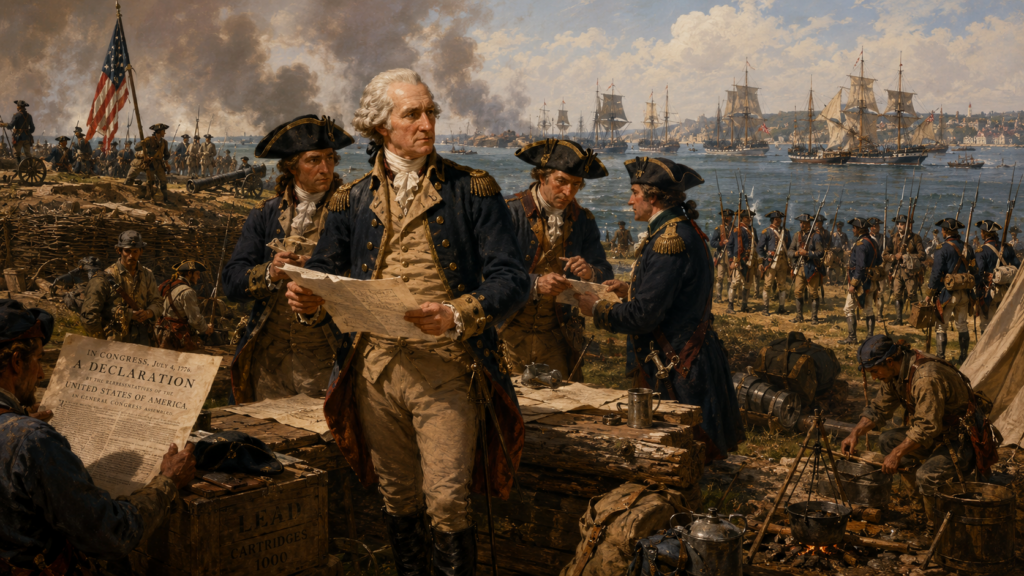
Exactly 250 years ago today (July 15, 1776), the fledgling United States was facing the stark, unglamorous realities of defending its newly declared independence.
What George Washington Was Doing
On July 15, 1776, General George Washington was stationed in New York, urgently preparing for an imminent and massive British assault.
- Reacting to British warships: Just three days prior, on July 12, British warships had boldly run past American batteries up the Hudson River (then called the North River). Washington spent this time sending urgent dispatches to the Continental Congress in Philadelphia to warn them that British Admiral Richard Howe’s massive fleet had arrived and that an attack on New York could begin at any moment.
- Reviewing intelligence: Washington was reviewing depositions and military intelligence concerning British ship movements and operations around New York Harbor.
- Promoting the Declaration: The New-York Gazette and Weekly Mercury published the text of the Declaration of Independence on its front page, noting that Washington had recently had the document read aloud to fire up the Continental Army regiments stationed in New York.
What Was Happening in the Revolutionary War
Across the colonies, the focus of the war on this day shifted from declarations of freedom to the desperate mobilization of men, shelter, and ammunition:
- The New York endorsement: The Second Continental Congress officially received and recorded resolutions from the convention of New York (which had met in White Plains). With New York’s formal approval, all 13 colonies had now officially unified behind and sanctioned the Declaration of Independence.
- The Flying Camp mobile reserve: Congress took steps to aggressively augment and organize the “Flying Camp,” a strategic mobile militia reserve composed of men from Maryland, Delaware, and Pennsylvania, rushing them to the ground between Philadelphia and New York to check the British threat.
- Conflict in the South (Battle of Lindley’s Fort): In the South Carolina backcountry, the war collided with the frontier. A joint force of around 190 British Loyalists and Cherokee warriors attacked a Patriot stockade known as Lindley’s Fort. The Patriot militia successfully repulsed the assault and launched a counter-offensive, marking an early Patriot victory in the Southern theater of the war.
- The arrival at St. George Island: In Maryland, a massive naval fleet of 70 to 80 British vessels began appearing off St. George Island in the Potomac River, aiming to forage for fresh water and supplies. This sparked a month-long campaign that would become Maryland’s largest Revolutionary War engagement.
This is a new feature we are experimenting with. It is our intent to run a Celebrating 250 day-in-history at least once per week; unless readers demand daily features. Please feel free to express your like or dislike for this feature at history@charitonmedia.com.